How we heat our homes and offices is a long running conversation. Is your approach ‘just put another layer on’ or do you feel life’s too short to be cold?
We have been balancing our desire to stay warm with the rising cost of energy since political unrest in the Ukraine and latterly, the Middle East. Now a new parameter has entered the chat – will gas or electricity run out or be switched off?
Only in October 2026 did the BBC publish a report with the headline ‘Lights will stay on this winter, grid operator says after concerns’.
Will gas and electricity run out?
The article covered an independent investigation into The National Energy System Operator (NESO) – the organisation that manages the overall electricity system in Great Britain. NESO rebuked the claim that we’d run out of electricity but it did admit there could be some ‘tight days’.
Over at The Guardian, the headline ‘UK risks running out of gas by 2030s, ministers told’ warned the Government about what may lie ahead. Perhaps in response, the new Jackdaw gas field in the North Sea has just got the green light.
Less energy used, more sustainability kudos
For business owners, there is a third energy question: does my office’s energy consumption harm my sustainability credentials? Minimum Energy Efficiency Standards (MEES) apply to commercial premises and the Government is looking to tighten the screw.
From 2031, it proposes all private rented buildings over 1,000 square metres in England and Wales should reach a higher standard of energy efficiency of EPC B, where cost effective.
Operating a sustainable office isn’t just about reducing energy bills for the occupant. Although that is important in the current economic climate. A company’s ESG (Environmental, Social and Governance) credentials are actively sought when choosing business partners, investors and suppliers. Run an electricity guzzling, carbon-heavy office? You may be overlooked in favour of a more sustainably-run businesses.
Accreditations that demonstrate commitment
Businesses have to walk-the-sustainable-walk by creating energy efficient offices and getting the correct accreditation. Demonstrating that your fixtures, fittings, construction methods and technology limits energy use is key when trying to achieve an accreditation from
BREEAM, LEED, SKA, or a scheme run by the Carbon Trust Standard, Investors in the Environment, B Corp, ISO 14001 and Green Mark.
A refit presents the best opportunity to upgrade an office’s infrastructure so it uses less energy and ticks more sustainable boxes.
Refitting to regain control
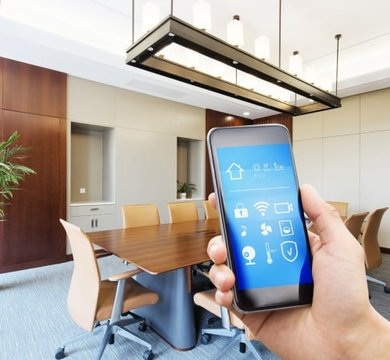
Smart lighting and climate control have a huge role to play in limiting energy consumption. An office’s comfort levels can be automatically controlled so there is zero waste and maximum comfort.
How does it work? Sensors, the Internet of Things (IoT) and Artificial Intelligence (AI) monitor an office’s humidity, temperature and lighting. It bases readings on occupancy and optimum desirability levels, adjusting without manual interference. This style of operation is important in the age of hybrid working patterns, when rooms and floors may be running under maximum occupancy.
Technology that cuts energy bills on a long-term basis has never been more attractive, especially when you look at the stats. Flexioffices found smart office technology can reduce operational energy use by 22% through occupancy-based control. When powered by AI and IoT systems, companies can cut total energy consumption by up to 33.8% and reduce carbon emissions by 40.7%.
Ultimately, smart occupancy and space monitoring can present a compelling case for relocating to a smaller office, which has the potential to reduce a wide-ranging set of overheads.
Increase reliance on renewable energy
Office refits also go hand-in-hand with the installation of PV solar panels, commercial battery storage systems, hybrid solar-plus-battery setups, thermal upgrades and the introduction of commercial-grade heat pumps.
MPL’s experience in planning and executing ‘shell and core’ refurbishments with complex Mechanical and Electrical aspects puts us in prime position to help businesses reduce their energy consumption. Working to high-level sustainability principles can also be followed through in our Cat A and Cat B fitout phases.
If you’d like to refit your office so there’s less reliance on fossil fuels, a switch to renewable energy and technology that automatically t keeps energy usage in check, please get in touch.